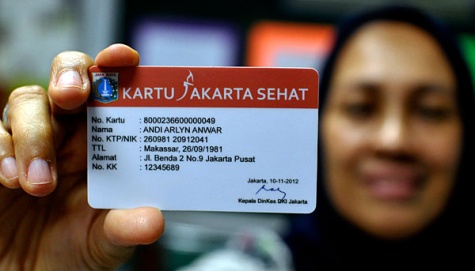
 IlustationA new health-care-for-all program in Jakarta is under scrutiny following the recent deaths of two patients who allegedly received inadequate hospital care. National officials are monitoring the city’s response ahead of the rollout of a government scheme to provide universal health care by 2019.
Last November the capital’s governor, Joko Widodo, launched a health care program that sought to cover all 10 million of Jakarta’s residents by 2014.
Under the initial phase of the program, called Kartu Jakarta Sehat (Healthy Jakarta Card), 4.7 million people will be eligible for affordable health care in third-class hospital wards (the cheapest ward, where one room is occupied by three or more patients) in more than 90 of the city’s 147 hospitals this year, said Dien Emawati, head of the Jakarta Health Department. The governor has said he wants all public hospitals to join the program.
“Kartu Jakarta Sehat has some shortcomings, but it’s working and it’s progress compared to the previous programs,” Dien said.
Unlike the health care scheme under the previous governor, residents are not required to prove their income status, a lengthy process that often involved bribing officials.
Automatic eligibility has resulted in an increase of up to 70 percent in the number of people treated, Dien said.
“Some hospitals have been overwhelmed by patients, partly because the program has prompted underequipped and understaffed puskesmas [government-run health clinics] to refer patients directly to hospitals [rather than attempting treatment first],” she said.
When local media reported the death of a premature baby in February after she was denied neonatal intensive care by at least eight hospitals, the public’s attention — and fury — turned on the new health care program.
The Health Ministry said the baby was not refused treatment because of the family’s inability to pay, but rather because a hospital’s neonatal intensive care unit was full, or it did not have such a facility.
In the latest case, a 14-year-old girl died from an intestinal infection on March 9 after hospitals reportedly denied treatment.
Government response
In response to the rising number of patients as well as complaints about inadequate treatment, Dien said her office is working with the University of Indonesia’s medical school and Cipto Mangunkusomo national hospital in Jakarta to improve health workers’ skills.
The Jakarta administration also seeks to strengthen the role of hospital medical committees to ensure appropriate treatment. The medical committee includes doctors appointed by the Jakarta government to oversee implementation of the citywide health care program and audit the appropriateness of treatment, including drug dispensation.
Following local protests over the baby’s death, the administration set up “Hotline 119” for people to get information on the availability of third class rooms in hospitals across the capital.
From most to least expensive, the hospital wards are classified as VVIP, VIP, first class, second class and third class. By law, at least 25 percent of a hospital’s wards must be third class.
Governor Joko has urged hospitals to convert some of their second class wards into third class ones to cope with rising demand for care among the poor, and warned of sanctions if patients were turned away based on income.
When the government rolls out universal health coverage in 2014, it may face similar problems as Jakarta does now, said Kartono Mohamad, a health care reform proponent and former chairman of the Indonesian Medical Association.
“In the first few months demand will be high [and] hospitals will struggle to cope,” Kartono said. “Even people with minor complaints will seek treatment. These kinds of things will need to be anticipated, both in terms of infrastructure and resources.”
“Trade-offs are inevitable” in trying to reach efficiency, equity and sustainability in health care access, concluded research on nine low and middle-income countries’ experiences with national insurance schemes.
Health insurance for all
Indonesia is seeking to provide all Indonesians with health insurance by 2019, as mandated by a 2004 law.
The government has set up an administering body called BPJS Kesehatan, which will begin operating in January 2014 with an initial investment of $2.6 billion to harmonize existing national and regional health schemes launched in recent years to help the poorest access health care.
Kartono said in the early phase of its operation, BPJS will take over the role of one of the state insurance companies currently covering 27 million residents, which means it will serve civil servants and salaried employees who already have insurance policies with that company. Both state insurance companies will eventually be disbanded and taken over by BPJS.
Currently about 60 percent of Indonesia’s 240 million people are covered by health insurance. A government health waiver for the poor, Jamkesmas, covers 76 million people while state-run insurance companies cover another 45 million.
There is still disagreement within the government about the amount of premiums to be paid to BPJS. The Health Ministry proposes Rp 22,000 ($2.30) per person monthly, with the government covering this for the poorest, while the People’s Welfare Ministry is seeking a lower premium of $1.50.
For universal health care to work nationwide, Indonesia also needs to regulate the pharmaceutical sector, Kartono said, adding that “invisible costs” like kickbacks to hospital staff and officials have boosted drug prices multifold.
“The absence of a drug policy has prompted pharmaceutical companies to compete to persuade hospitals and doctors to prescribe their products. The practice leads to doctors being bought and as a result, drugs have become increasingly expensive,” he said.
Indonesia has 25 health workers per 10,000 residents on average — which meets the World Health Organization’s minimum of 23 workers per 10,000 residents — but most of this resource is in urban centers, leaving parts of the archipelago completely uncovered.
“The idea of universal health coverage as mandated by the law is still far off,” Kartono concluded.
source: http://www.thejakartaglobe.com
BL Pembiayaan
Policy Paper
